
Six ways to build hybrid into your school mix?
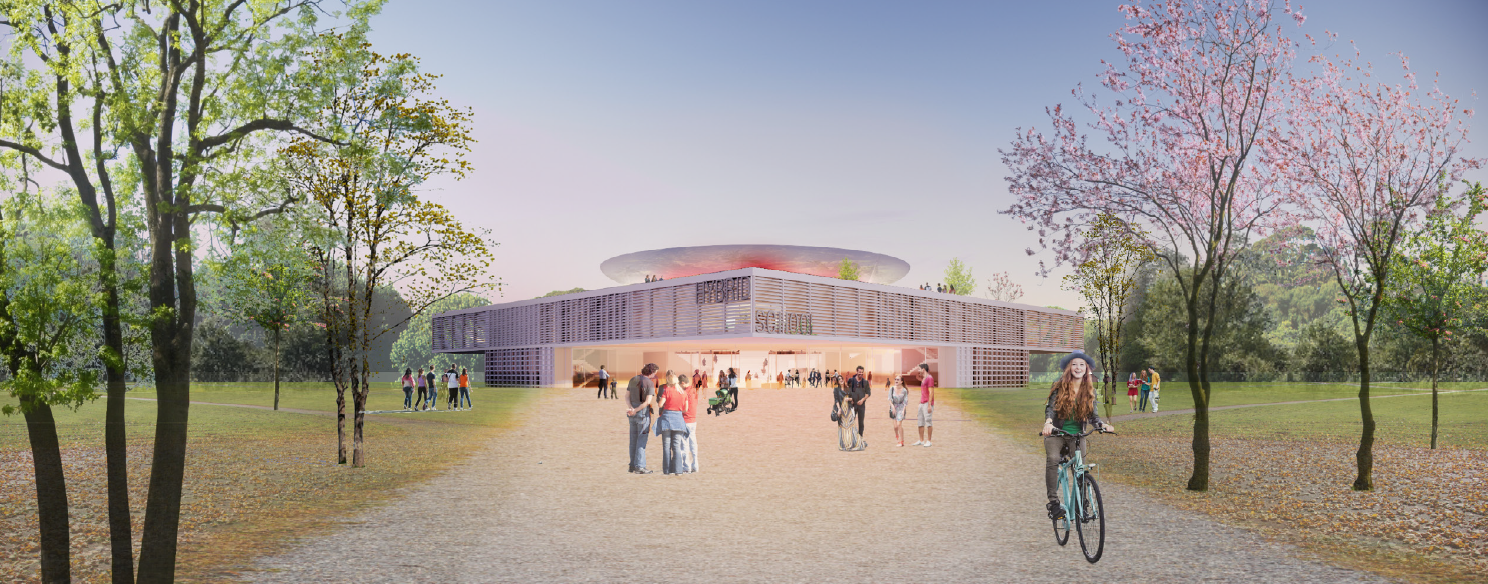
Proof-of-concept hybrid school design produced by Jestico+Whiles
What is Hybrid Schooling?
Hybrid schooling has three components: face to face teaching, remote teaching usually using a video conferencing tool, and individualised study on a personalised learning platform. Thus, hybrid education is more about the ways in which schools interact with students, than it is about location. It is quite possible for a student to be in school for the whole week and be taught using the hybrid model; with part of the day being taught in a class with a teacher, part of the day in a remote lesson; and part of the day working on a learning platform.
Six ways to build hybrid into your school mix:
1. Upskill your remote teaching capability by embracing developments in remote teaching pedagogy
Remote Teaching Pedagogy is at a formative stage, but online schools are at the forefront of the developments in online pedagogy. The way in which online schools conduct remote teaching is a far cry from what most families experienced during Covid. Indeed, it is increasingly being recognised that teaching remotely requires a different set of skills from what is required in a bricks-and-mortar classroom. The University of Derby is even offering a Post Graduate Certificate in Online Teaching. The Online Schools use sophisticated learning platforms, such as BigBlueButton, that allow teachers to combine content delivery, to run polls and to establish and manage break-out rooms. They also have communication tools that allow teachers to check in on individual students, as well as to communicate with the class. Further developments are coming down the line. Campus-XR, a VR start-up, is developing an immersive lab that will allow students to conduct all of the their GCSE science experiments through VR. Virtual reality gives remote students the opportunity to get (virtual) hands-on experience without significant cost of maintaining and staffing a school lab. If we can train our eye surgeons to perform operations in VR, why can’t our GCSE students learn their practical skills in VR? Remote teaching pedagogy is still work in progress, but there is much that mainstream schools and groups can learn from what they are doing.
2. Address staffing shortages
Given the growing shortage of specialist teachers in some subjects, it would make sense for schools to move a portion of their sixth form teaching to remote teachers working with students who log into lessons while in school. All the indications are that there is no shortage of highly qualified teachers who want to teach remotely. One of the greatest challenges that schools face is providing cover when teachers are absent. One way in which schools might build hybrid into their school mix is to build a relationship with online providers who can step in for the short term to provide expertise to cover a mid-year maternity or long-term sick absence.
3. Outsource Low Uptake Subjects
Sadly, most schools have a number of GCSE, A-level and IBDP subjects, often modern languages, where current student uptake means that these subjects represent a significant cost to the school. In these circumstances, one way that schools can reduce costs without reducing their curriculum offering, is to move those low-uptake subjects online. There are now a range of external providers, both online schools or tutoring agencies providing B2B services, who not only will provide remote teaching within the school timetable for the whole course, but will also write reports into the school’s MIS and participate in parent-teacher meetings. Furthermore, offering online teaching is a cost-effective way in which schools can expand their curriculum offering, say by offering Italian, Russian in addition to the traditional French, Spanish and German.
4. Reduce international school staffing costs
The rising costs international expat packages makes engaging a proportion of your specialist teaching staff on remote teaching contracts a very attractive proposition. When one takes into the account the salary, housing allowance, end of contract gratuity flights - not to mention, medical insurance and visa costs (which may extend to spouse and dependants) – the cost of taking on a remote teacher can be less than half that of the expat teacher. The British School Muscat in September 2025 introduced Psychology A-level delivered remotely. This option proved popular with parents and students alike, and the school was able to introduce the subject without having to engage a part-time teacher on an international expat package.
5. Flex your school into the hybrid market
Why not flex your current school into offering a parallel hybrid curriculum? It is far easier for bricks-and-mortar schools to flex into hybrid than it is for online schools to do so. Online schools have business models that are predicated on a low-or-no physical assets. Conversely, traditional schools already have physical assets so flexing into hybrid requires significantly less capital investment. It would be relatively easy for schools, particularly international schools, to offer a limited hybrid curriculum with students coming into school for part of the week. This model has been pioneered by The Dukes Education Hybrid which is attached to their bricks-and-mortar school in London.
6. Build Hybrid
Finally, the ultimate way to build hybrid into your school mix is to build a hybrid school. It can be argued that schools perform three important functions in our society. First, they provide childcare so that parents can go to work. Second, they provide opportunities for children and young people to develop socialisation skills. And third, they are places where children and young people acquire knowledge and understanding. Traditionally schools have been designed around classrooms and academics. The advances in technology and pedagogy mean that academics can be delivered in a range of new ways This allows for a whole rethink of what schools are. Hybrid schools can be designed - both in terms of physical environment and how they apportion time – around the most human of activities, socialisation. And that is a very exciting prospect.